





Penetrations in Floors
References: R Record keeping requirement | E An engineering/certification requirement | P A permit to work requirement | S A safe work method statement (SWMS) / written plan
This section is to be read in conjunction with the following sections:
- Formwork
- Work @ Heights General
- Edge Protection
- Lift Shafts (for vertical penetrations)
- Barricading and Signage and
- Roof Work
Operational
Penetrations in Floors (Horizontal Surfaces)
Any horizontal penetration i.e. opening in a floor including holes, voids or openings (other than stairwell, lift well, or vehicle inspection pit, or pour through opening in jump form) which presents a risk of a person or object falling, may reasonably be expected to fall must be protected:
- (WA) Penetrations include openings with dimensions 200 mm × 200 mm or greater and less than 2 m × 2 m.
- (NSW, QLD, VIC) Penetrations include any opening through which a person or object may reasonably be expected to fall.
Penetrations must be protected by:
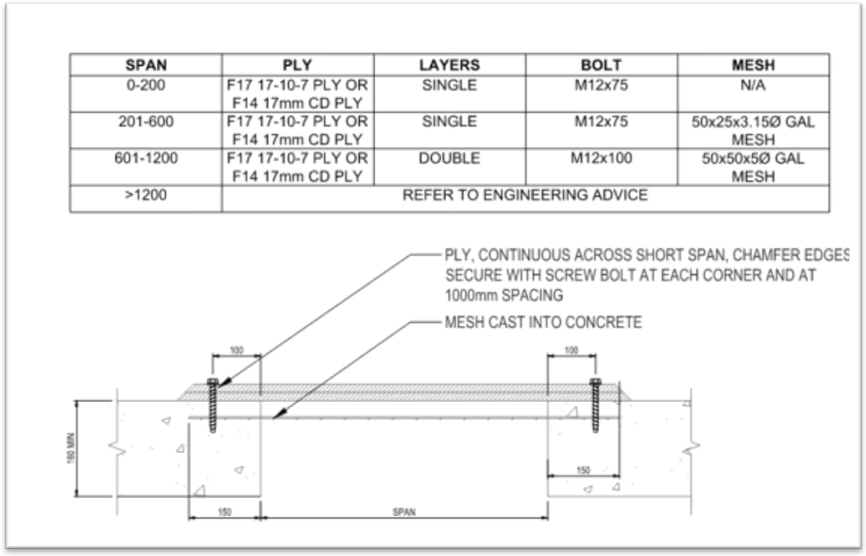
- A secure cover, refer Table 1 below, and /or
- If a cover is not practical, edge protection system (refer section: Edge Protection)
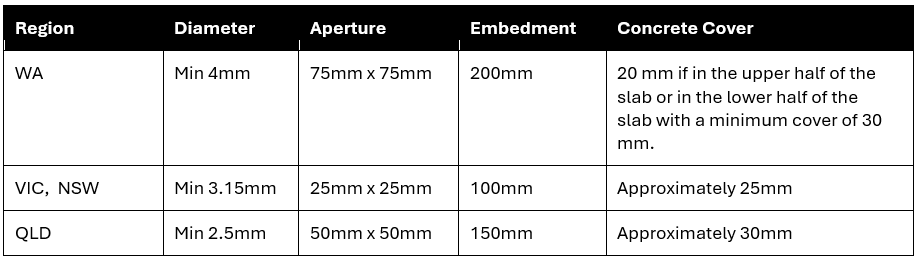
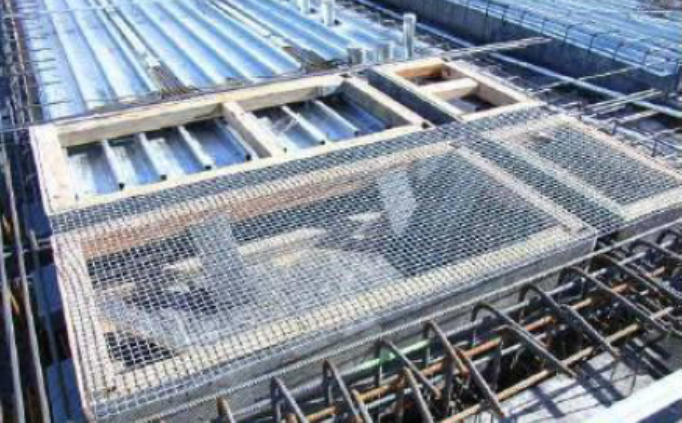
For penetrations in concrete floors, cast-in wire mesh in accordance with Table 1.
Wire mesh used in penetrations must not be used as a working platform.
Penetrations Covers
Any cover used to protect a penetration in a floor or other trafficable structural surface (e.g. roof, pit etc.) must be:
- Securely fixed in place
- Clearly marked with paint or signage
- WA: must state ‘DANGER HOLE BENEATH’
- NSW, QLD, VIC: must clearly identify that a penetration exists (e.g., “PENO” “PENETRATION – DO NOT REMOVE”, “HOLE BELOW” or project approved wording)
- Capable of withstanding foreseeable loads, for example:
- Personnel Only: able to withstand a 2 kN (i.e. 200kg) point load.
- Plant / Materials Storage: protected by a trafficable, capacity/load‑rated cover engineered to withstand the imposed loads (e.g., steel plate or engineered structural plywood)
- Free of slip / trip hazards – e.g. if located in a designated accessway, bevelled edges
Where mobile plant is expected to operate near a penetration, and the penetration cover is not rated for mobile plant loads, the penetration must be protected to prevent mobile plant access by:
- Installing edge protection or suitable barricading and signage around the penetration; and/or
- Installing timbers, wheel stops or similar physical barriers to prevent plant access to the cover, or
- A dedicated spotter/observer
Removal and Reinstatement of Penetration Covers or Edge Protection
Covers or edge protection must only be removed immediately prior to commencing any work associated with the penetration, after work related controls are established. Covers and/or edge protection must be reinstated as soon as practicable once the work is completed.
Where a penetration cover or edge protection is required to be removed to facilitate work (e.g. the installation of walls, services or similar), the following controls must be in place before the work commences:
- S Implement fall and/or falling object risk controls as described in the applicable SWMS (e.g. edge protection installed, exclusion zones established below the work area via overheard works coordination, tool tethering, height access equipment, height safety equipment)
- Establish barricading and signage at the working level and/or below to define exclusion zones.
Removal of Cast-In Wire Mesh
Where cast-in wire mesh is required to be removed to allow services installation or similar works, the wire mesh
- Must only be removed (cut-out) immediately prior to the installation; and
- Be restricted to the specific area required for the installation work.
Services in Penetrations (Risers)
Where vertical riser penetrations have had wire mesh removed and service(s) installed, the riser must be protected by:
- Edge protection, and either:
- A cover as defined above; or
- Where ductwork (e.g. mechanical) is installed, the duct should extend to a minimum of 900mm above the finished floor level (where practicable)
Where it is no longer practicable to reinstate the penetration cover (e.g. the riser walls are built on 3 sides), and there is a potential risk of fall, the penetration in the floor must be protected by suitable edge protection.
Lift Door Opening
Where lift door openings are protected by temporary covers (acting as edge protection) the temporary cover is to be replaced by the proprietary lift shaft gate prior to lift installation work occurring and until such time as permanent lift doors are installed.
See Section: Edge Protection and Lift Shafts
Legal and Other Requirements
- Work / Occupational Safety & Health / Regulations
- Formwork Code of Practice (QLD) 2016
- AS 1657 – Fixed platforms, walkways, stairways and ladders – Design, construction and installation
- AS/NZS 4994.1– Temporary Edge Protection – General Requirements
- AS/NZS 1576.1– Scaffolding – General Requirements
- AS/NZS 2269.0– Plywood – Structural, Specifications
- AS/NZS 1170.1 - Structural design actions, Part 1: Permanent, imposed and other actions
- AS/NZS 1170.0 - Structural design actions, Part 0: General principles
Document Control
Version 1 August 2019 – New Procedure
Version 2 9th May 2022 - Inclusion of the requirements for vertical risers which have had the wire mesh removed and service installed
Revision 3 April 2026 – Key changes:
- Clarified penetration definitions across jurisdictions, adopting a risk‑based approach (“potential risk of fall”) and including WA dimensional thresholds.
- Replaced the WA-only requirement to verify penetration cover capacity with prescriptive controls to prevent mobile plant access, including use of barriers, edge protection/barricading, and spotters where covers are not load‑rated.
- Replaced general requirements for removal of penetration protection with structured controls, including SWMS‑aligned risk controls, formal reinstatement requirements, and specific provisions for controlled removal of cast‑in wire mesh limited to the minimum required area.
- Added QLD‑specific cast‑in wire mesh requirements to the table, including revised criteria for diameter, aperture, embedment, and concrete cover to align with jurisdictional differences.